
Why RAM Prices Are Surging in 2026 in South Africa — What It Means for Businesses and How to Adapt
Businesses across South Africa are noticing a steady rise in hardware costs in 2026. Laptops cost more to configure. Servers are more expensive to expand. Memory upgrades that were once minor line items now materially affect IT budgets.
The increase in RAM pricing is not isolated. It reflects broader global semiconductor market shifts driven by artificial intelligence infrastructure growth, data centre expansion, and strategic production decisions by memory manufacturers.
This article explains what is driving RAM price increases in 2026, how global semiconductor dynamics affect South African businesses, and what practical steps organisations can take to adapt.
Why RAM Prices Are Increasing in 2026 — What the Data Shows
TrendForce, which tracks global DRAM pricing, has reported sustained price increases in both DRAM and NAND segments as suppliers reduce production of lower-margin products and shift toward higher-value memory types.
The Semiconductor Industry Association (SIA) has also reported strong global semiconductor revenue growth driven by data centre and AI demand, reinforcing that demand remains structurally high.
IDC’s semiconductor research similarly highlights that AI and data centre expansion are significantly influencing memory demand patterns (https://www.idc.com/promo/semiconductor).
These market signals collectively point to sustained pricing pressure rather than a short-term fluctuation.
1. AI and Data Centre Demand Are Reshaping the Market
According to IDC and multiple semiconductor industry analysts, demand from AI infrastructure and hyperscale data centres has surged dramatically in 2025 and 2026.
High-bandwidth memory (HBM), used in AI accelerators and enterprise servers, commands significantly higher margins than standard commodity DRAM used in consumer laptops and SME servers. Manufacturers such as Samsung, SK Hynix, and Micron which together control the majority of global DRAM production have increasingly allocated wafer capacity toward these higher-margin enterprise products.
Micron’s investor updates emphasise strong demand for data centre and AI memory products and highlight that enterprise memory segments are delivering improved margins compared to consumer-focused segments.
Industry reporting from Tom’s Hardware and IDC indicates that data centres may consume as much as 60–70% of global memory supply in 2026. This reallocation reduces availability for mainstream PC and SME markets.
The economic logic is straightforward: when fabrication capacity is limited, manufacturers allocate production toward higher-margin products.
2. Structural Supply Constraints
Unlike previous memory cycles, today’s pricing environment is not purely cyclical. It reflects a longer-term structural imbalance.
Factors include:
-
- Limited advanced fabrication capacity
- High capital expenditure requirements for new fabs
- Multi-year lead times for production expansion
- Supply chain bottlenecks in substrates and specialty materials
The Semiconductor Industry Association (SIA) has reported record industry revenues, largely driven by AI and data centre demand, but supply growth has not kept pace with the shift toward high-performance memory types.
New fabrication plants announced by major manufacturers will not meaningfully increase capacity until 2027 or later.
3. NAND and SSD Prices Are Also Climbing
RAM is not the only memory segment under pressure. NAND flash, used in SSD storage, has also experienced upward pricing movements. Industry reports in 2025–2026 from PC Gamer and supply chain analysts showed NAND wafer price increases exceeding 200% in certain periods due to production adjustments and tight supply.
This affects:
-
- Business SSD upgrades
- Server storage arrays
- Laptops with high-capacity solid-state drives
Because both DRAM and NAND influence laptop and server pricing, businesses often experience compounded hardware cost increases.
Why Manufacturers Prefer Data Centres Over Consumer Electronics
The shift in supply allocation is primarily economic.
Higher Margins
Enterprise memory products such as HBM and data centre-grade modules command significantly higher profit margins than commodity DRAM sold to laptop OEMs.
When capacity is constrained, manufacturers naturally prioritise higher-return products.
Long-Term Contracts With Hyperscalers
Large cloud providers and AI infrastructure operators often secure long-term supply agreements at premium prices.
These contracts guarantee revenue stability for manufacturers and reduce supply available to general markets.
Price Arbitrage and Strategic Focus
In a constrained environment, selling into AI and hyperscale markets generates greater revenue per wafer than supplying consumer devices. As a result, production strategies favour enterprise demand.
For South African businesses, this means the devices they purchase compete indirectly with global AI infrastructure demand.
The Ripple Effect on South African Businesses
Memory now represents a larger percentage of overall PC bill of materials than in previous years. Industry commentary from major OEMs suggests that RAM costs have, in some quarters, doubled as a share of device manufacturing cost. When suppliers pass those costs downstream, businesses feel the difference.
A standard business laptop configured with 16GB or 32GB RAM now costs noticeably more than equivalent configurations in 2022–2023.
2. Server and Virtualisation Cost Increases
Servers are far more memory-intensive than laptops. Virtualised environments, ERP systems, and databases rely heavily on RAM.
When memory pricing rises:
-
- Server refresh projects become more expensive
- Infrastructure expansion is delayed
- Budget forecasts must be revised
3. Cloud Cost Indirect Pressure
Although cloud providers operate at scale, their infrastructure relies on the same global semiconductor supply. Sustained component price increases can influence instance pricing, especially for memory-optimised workloads.
The Financial Impact: Higher TCO and Budget Volatility
The effects go beyond upfront purchase price. Higher hardware costs increase total cost of ownership (TCO), particularly when businesses delay refresh cycles to avoid capital outlays.
Older hardware introduces:
-
-
Higher failure risk
-
Increased security exposure
-
Reduced productivity
-
Limited compatibility with modern software
-
The hidden cost of deferring upgrades may exceed the savings of postponing purchases.
How Businesses Can Adapt Strategically
Rising RAM and semiconductor prices do not mean businesses must freeze investment. It means procurement strategies must evolve.
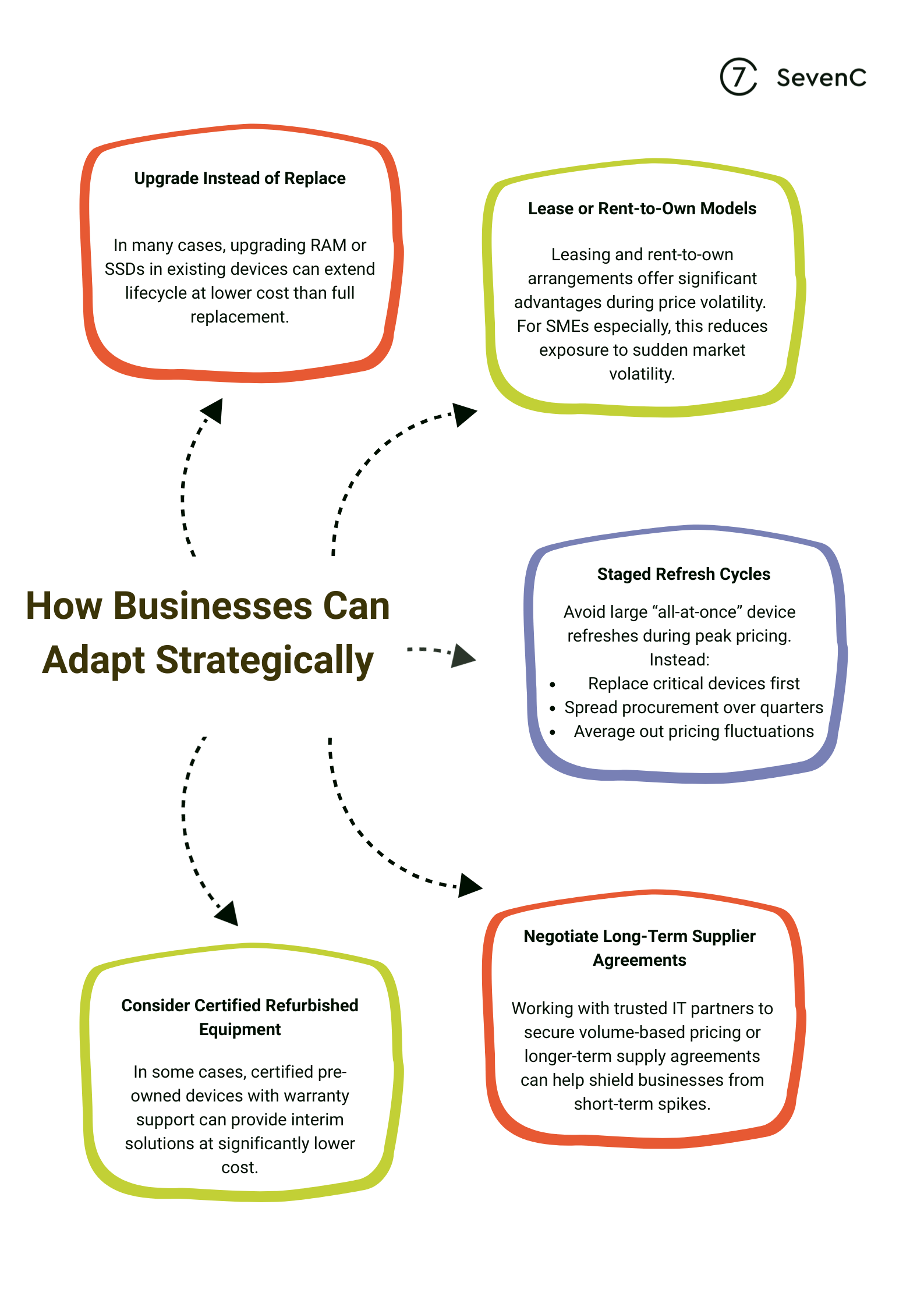
1. Upgrade Instead of Replace
In many cases, upgrading RAM or SSDs in existing devices can extend lifecycle at lower cost than full replacement.
For example:
-
- Increasing RAM from 8GB to 16GB may restore productivity
- Replacing spinning disks with SSDs can significantly improve performance
This approach preserves capital while maintaining performance.
2. Lease or Rent-to-Own Models
Leasing and rent-to-own arrangements offer significant advantages during price volatility:
-
-
Reduced upfront capital expenditure
-
Predictable monthly cost structure
-
Preservation of working capital
-
Easier technology refresh cycles
-
Alignment of technology lifecycle with cash flow
-
Instead of absorbing a large price spike in one purchase, costs are distributed over time.
For SMEs especially, this reduces exposure to sudden market volatility.
3. Staged Refresh Cycles
Avoid large “all-at-once” device refreshes during peak pricing.
Instead:
-
-
Replace critical devices first
-
Spread procurement over quarters
-
Average out pricing fluctuations
-
This reduces risk and improves budgeting accuracy.
4. Negotiate Long-Term Supplier Agreements
Working with trusted IT partners to secure volume-based pricing or longer-term supply agreements can help shield businesses from short-term spikes.
5. Consider Certified Refurbished Equipment
In some cases, certified pre-owned devices with warranty support can provide interim solutions at significantly lower cost.
Outlook for 2026 and Beyond
Most industry analysts agree that memory pricing will remain influenced by AI and data centre demand through 2026. TrendForce and IDC reporting suggest that memory markets have shifted structurally toward enterprise and AI consumption patterns rather than traditional PC cycles.
Meaningful price stabilisation may depend on new fabrication capacity becoming operational and a moderation in AI infrastructure growth.
Until then, volatility remains likely. In other words, businesses should plan for sustained volatility rather than a rapid correction.
Turning Price Pressure Into Strategic Advantage
RAM price increases in 2026 are not isolated events. They reflect a fundamental shift in global semiconductor economics. Data centre and AI demand now dominate allocation decisions. Manufacturers prioritise profitability. Supply remains constrained. Prices rise accordingly. South African businesses cannot influence global wafer allocation, but they can influence how they respond.
By:
-
- Upgrading strategically instead of replacing blindly
- Using lease or rent-to-own models to smooth capital exposure
- Staggering refresh cycles
- Negotiating smarter procurement agreements
Organisations can remain competitive without absorbing unsustainable cost spikes. The businesses that treat technology procurement as a strategic discipline, rather than a reactive expense, will navigate this volatility far more effectively than those who wait and hope for prices to fall.
RAM price increases in 2026 reflect a global realignment of semiconductor economics. Data centre and AI demand are reshaping supply allocation. Enterprise margins are higher. Capacity expansion is slow. These are structural shifts, not temporary disruptions.
South African businesses are downstream participants in this global shift. That reality cannot be controlled. What can be controlled is how technology investment is planned, financed, and aligned to business outcomes. By adopting leasing models, staging refresh cycles, upgrading strategically, and partnering with the right technology advisor, organisations can protect cash flow while maintaining performance and security.
At SevenC, we believe IT should give you clarity and continuity, even in volatile markets. With the right strategy, rising hardware costs do not have to slow your growth. They simply require smarter planning, stronger partnerships, and IT by design — built around your business, not the market cycle.

Recent Comments